
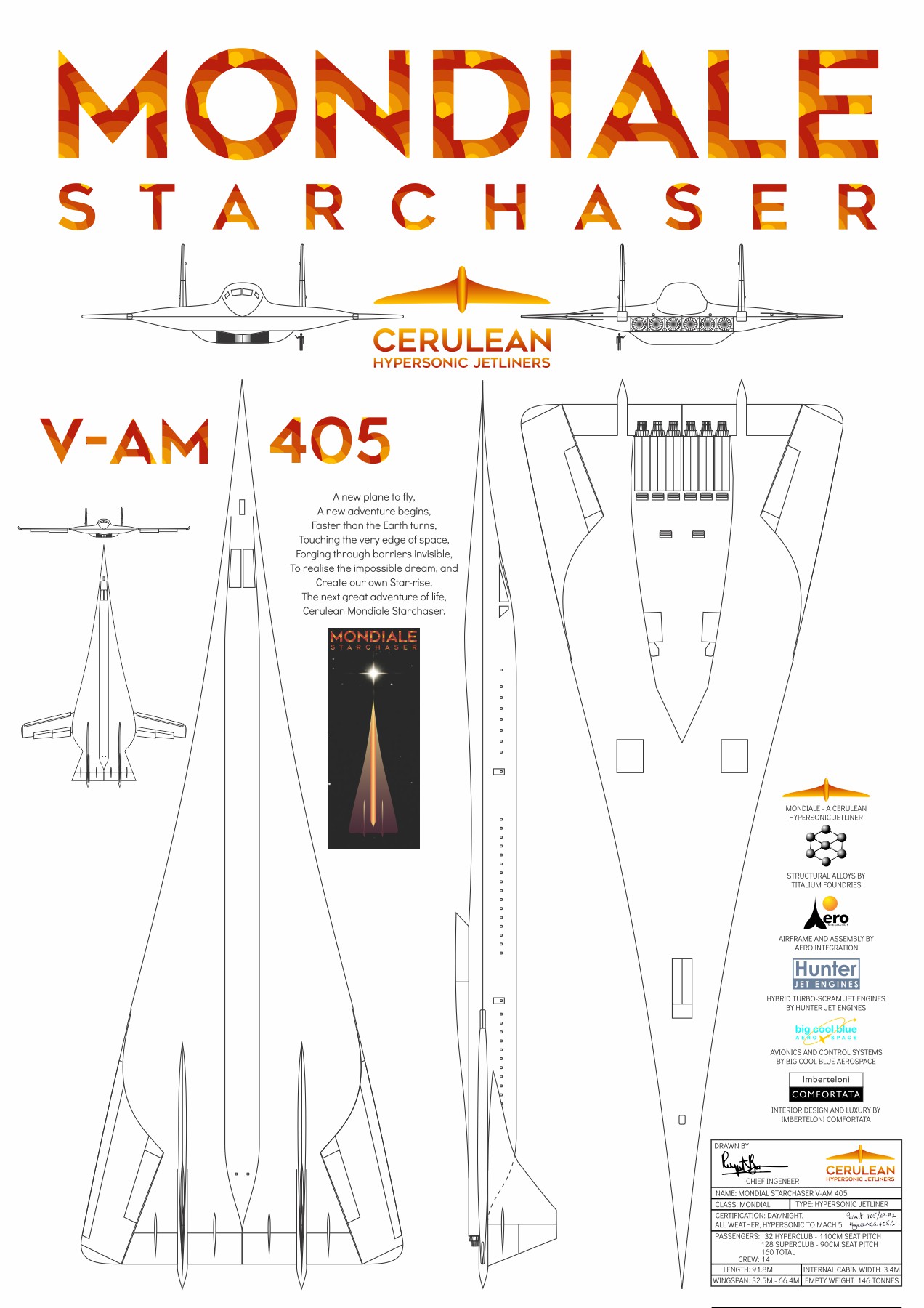
The Mondiale Starchaser Plan Poster showing the external configuration of the aircraft.
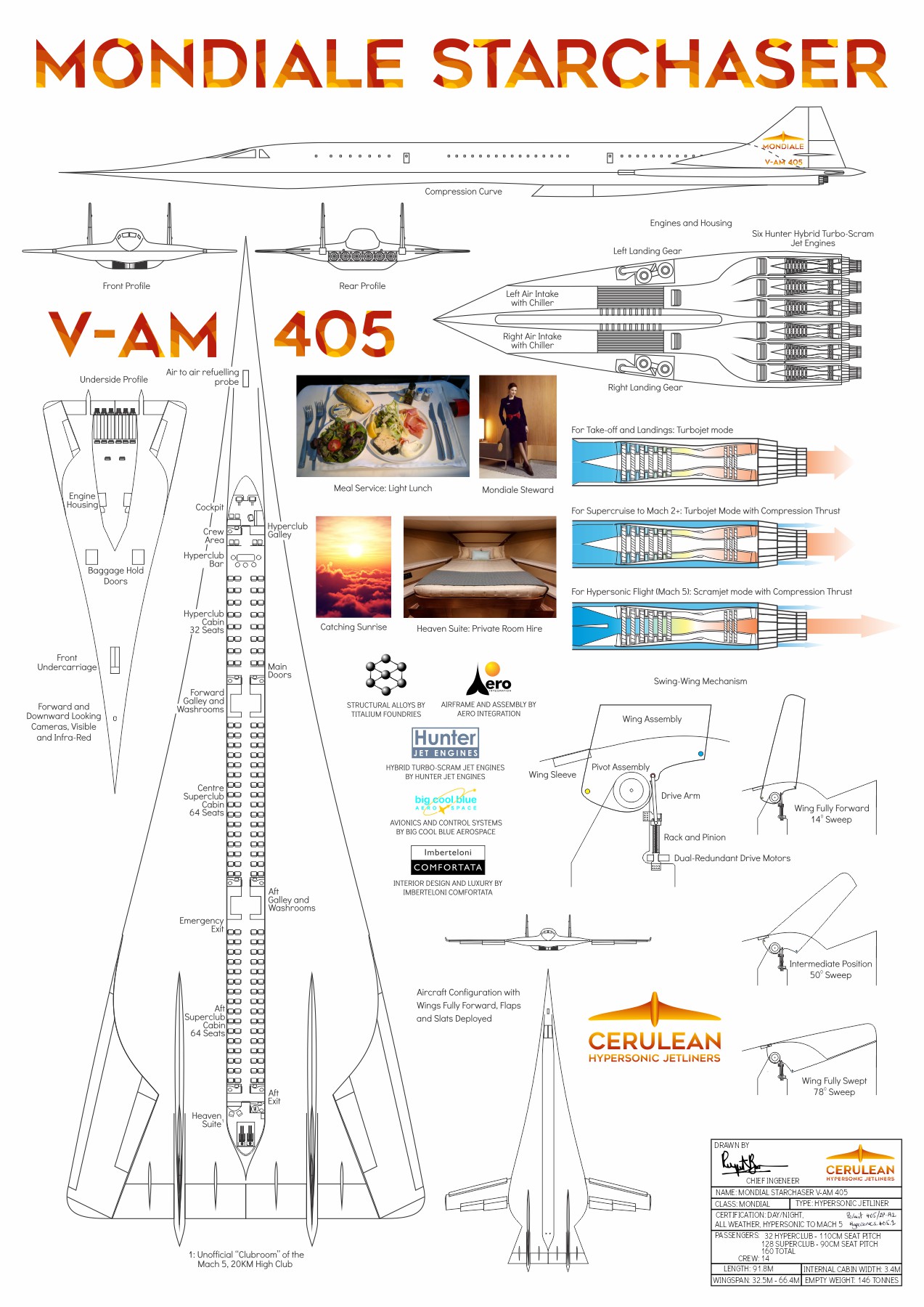
The Mondiale Starchaser Layout Poster showing the internal configuration of the aircraft.
Inspiration
The dream is to go fast, to dramatically reduce journey times, to fly people in comfort at speeds well beyond that of the speed of sound. Only one aircraft has ever achieved that feat - the British-French Concorde, and it did it so well. Even today it probably represents our greatest aviation achievement. The Russians almost got there with the TU-144. The Americans never did. It would have been too simplistic just to rework Concorde. Instead I found inspiration in a series of remarkable aeroplanes produced by Lockheed, Rockwell and North American.
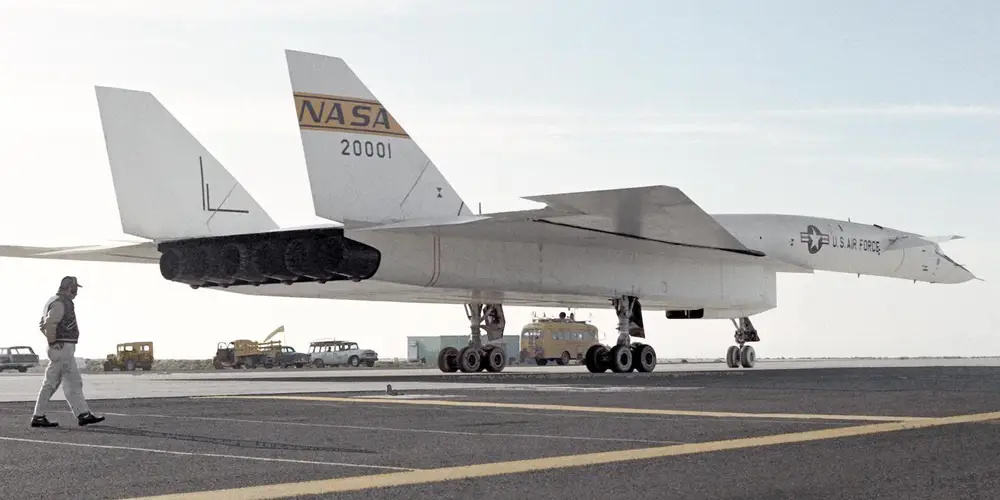
Concorde could super-cruise at mach 2. Mondiale has to be better and fly at mach 5. That kind of speed requires a huge amount of power, and one aeroplane from the 1950s offers a configuration that you could believe would make mach 5 - the North American Aviation XB-70 Valkyrie. It was equipped with six General Electric YJ93-GE-3 turbojet engines in a single structure under the delta wing. The XB-70 did get to mach 3 - a beast.
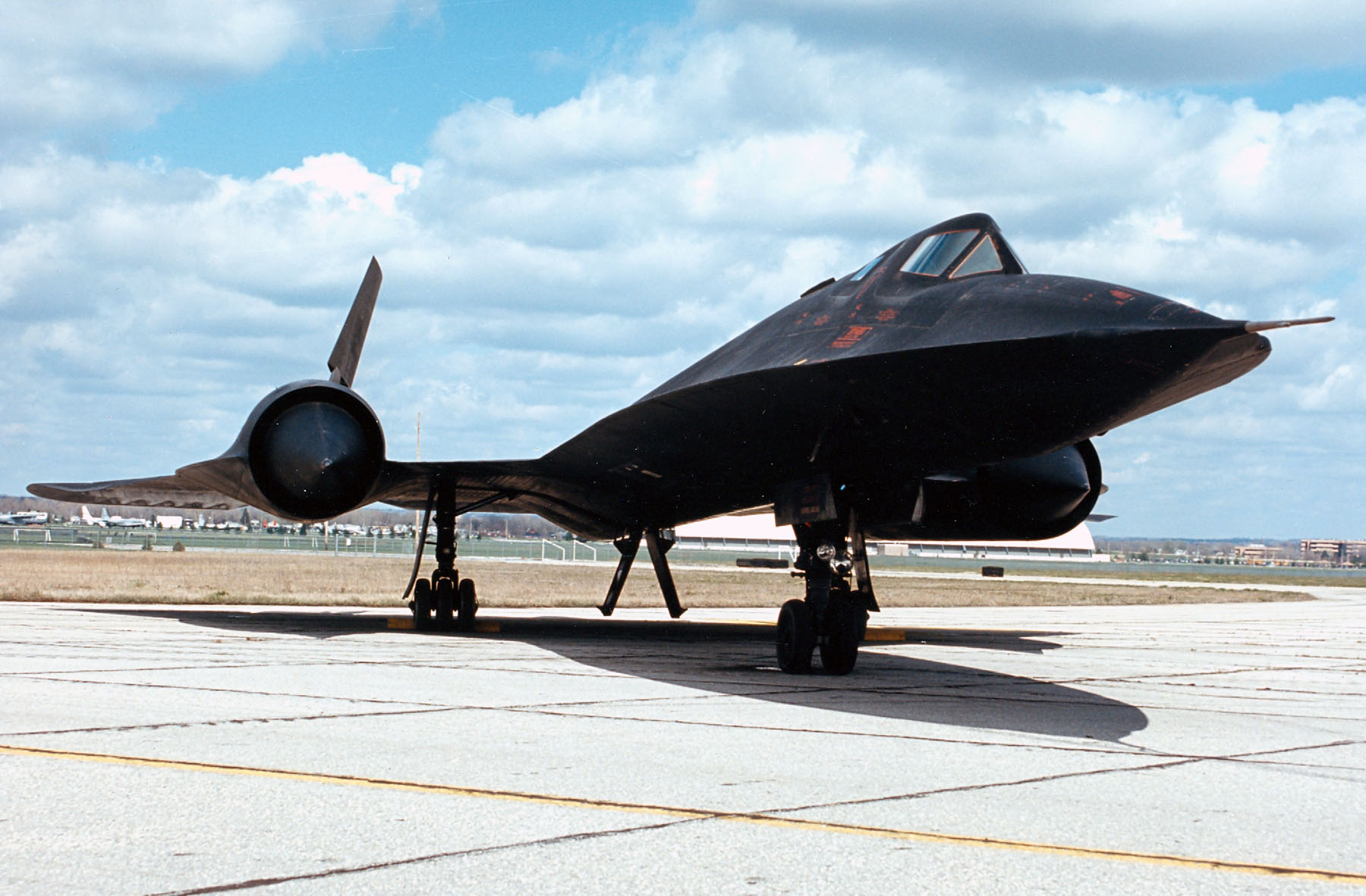
As soon as you start talking about speeds in excess of mach 1, aerodynamics become so important because of drag and the build up of heat in the fuselage due to skin friction. At mach 2, parts of Concorde reached over 120 degrees centigrade. At mach 5 things get a lot worse. It's no longer sensible to think of wings joining a central fuselage - the whole structure has to be one smooth continuous set of curves - the blended wing. One of the greatest exponents of this idea was the Lockheed SR-71, another mach 3 aeroplane.
As you build an airframe capable of sustaining mach 5 you run into another problem - landing and taking off. The aeroplane has to generate enough lift at low speed to get into the air. There is another aeroplane that demonstrates a dramatic solution to this problem - the swing wings of the Rockwell B-1 bomber. For take-off and landing the wings are swept forward and flaps deployed. For high speed flight the wings fold back.
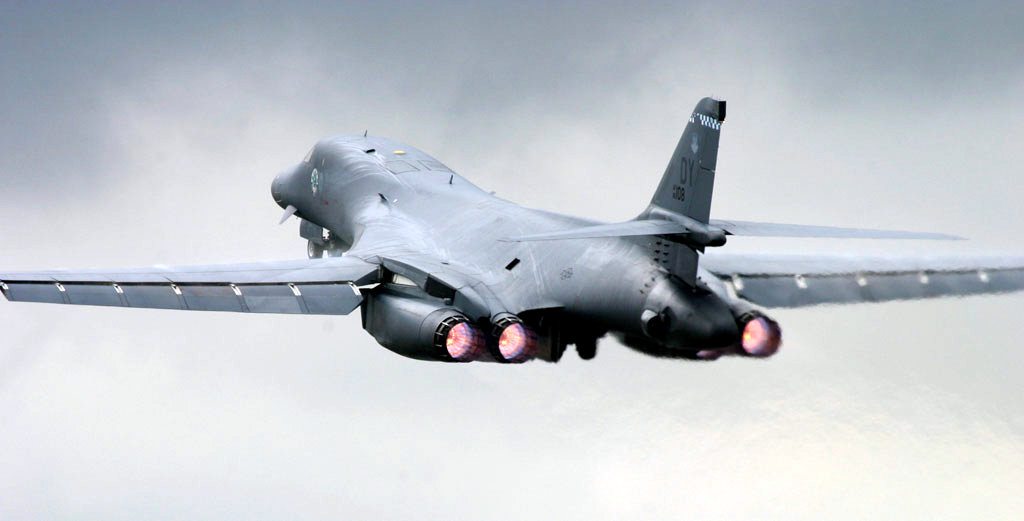
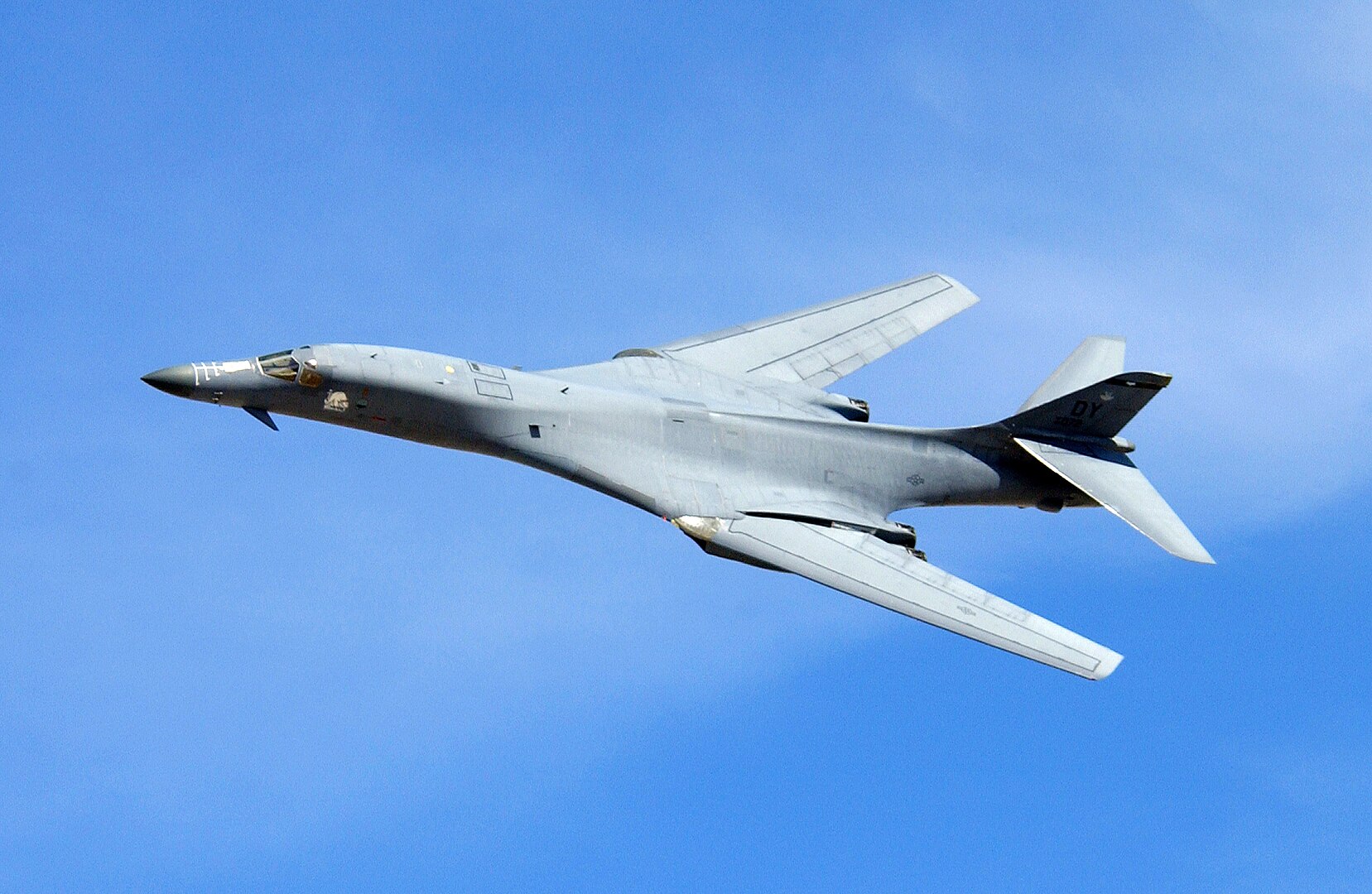
I put those three ideas together with some added innovation - and Concorde's ability to carry passengers in luxury - and came up with the Mondiale Starchaser.
Mondiale Starchaser backstory
For Cerulean, the Tarkine Transglobal proved that you could travel to any point on the Earth in a single flight. With Mondial they wanted to do that again, but this time cut the travel time down, to anywhere, to a few hours. That meant they were chasing a hypersonic aeroplane.
Work started in earnest at the beginning of 1960 at Toulouse and Filton. During the 1950s Cerulean had completed several design studies to determine the new technologies they would need to develop for Mondiale. Not surprisingly these studies revealed that major advances were required in airframe and engine materials, propulsion systems, aerodynamic design and flight control systems. The first breakthrough came in the form of Certanium, an alloy as strong as titanium but lighter and with better heat resistant properties. Crucially Certanium enabled the development of the variable geometry engine and reduced the weight of the swing wing mechanism to an acceptable level.
Flight test trials started in 1969 with the first flight leaving Filton, closely followed prototype 2 taking off from Toulouse. The flight test programme was very smooth and Mondiale entered service in 1973. Operations went well but factors came into play that limited the market for Mondiale. The USA banned supersonic flight over land because of the disruption caused by the sonic boom. In the end the big American airlines turned away from Mondiale in favour of larger but slower conventional subsonic passenger aircraft. Customers did like the much faster transatlantic journey afforded by Mondiale.
To make up for the loss of sales in the USA, Cerulean turned to the Asian carriers and the possibility of much longer range trips. Mondiale was limited by the fuel it could carry, but this problem was solved by modifying Mondiale to be able to refuel in flight. This lead to the development of the non-stop service to Australia which only took roughly half a day. When it came to luxury, long range, hypersonic travel Mondiale was peerless. Below is a Mondiale Starchaser publicity poster from the time.

The Mondiale Starchaser was a unique aeroplane. Flying Mondiale was like flying in one of the World's most exclusive clubs. It was the closest people could get to going into space. On the London to Melbourne flight Mondiale headed North and flew over the North pole, then headed South over the Pacific Ocean. This was to keep the sonic boom away from populated areas. The London to New York flight took a couple of hours. London to Melbourne took around six with the plane air to air refuelling over the North Pacific from Cerulean VC10 tankers operating out of Canada.
Mondiale Starchaser short story "Devil's Cupid"
Read the Mondiale short story Devil's Cupid. Only Mondiale has the speed necessary to get a deadly virus from Victoria to Cambridge for crucial DNA analysis work.
Mondiale Starchaser plan
The natural home of the Mondiale Starchaser is a brutal and violent place. Mach 5 at an altitude of 20 km, the only other man made thing that ventures there is a rocket on its way to space. To be able to exist in that place, Mondiale absolutely relies on its slim, delta shape to force its way through an atmosphere which although thin, at Mach 5 exerts a crushing force. What works at an altitude of 20 km unfortunately does not work for take off and landings. In both situations Mondiale would have to go too fast to be safe, and require a runway of an unacceptable length. Its great trick is its ability to change shape. As it reduces speed, it swings its wings forward generating the lift it needs to control flight.
Mondiale's distinctive chin serves a very important purpose. It creates a shockwave and compresses the air as it enters the engines. This compression is vital for the successful and efficient operation of the engines when they are in scramjet (supersonic-combustion ramjet) mode.
Mondiale Starchaser layout
One of the most challenging aspects of hypersonic flight is having engines that can sustain speeds of Mach 5 and above. The fans in conventional jet engines become a less than optimal solution at speeds of Mach 3 and above. The firm of Hunter Jet Engines solved the problem for Mondiale. Much like Mondiale has variable aerodynamic geometry, the Hunter engine can reconfigure itself in flight. It starts as a conventional turbojet. Once speeds in excess of Mach 2 are reached, air is channelled away from the fan and through the central core of the engine which now acts as a scramjet. In this way the aircraft is able to reach and sustain flight at Mach 5.
The seating inside Mondiale was comfortable but compact. This was acceptable because even flights half way round the World only took six hours. Through a window you would see a black sky, the blackness of space, and Mondiale was fast enough to catch a setting Sun. For the more adventurous passenger, Mondiale also offered the enigmatic "Heaven Suite".