AIRCAT
OCEANIC
The Aircat story with the plan and layout posters.
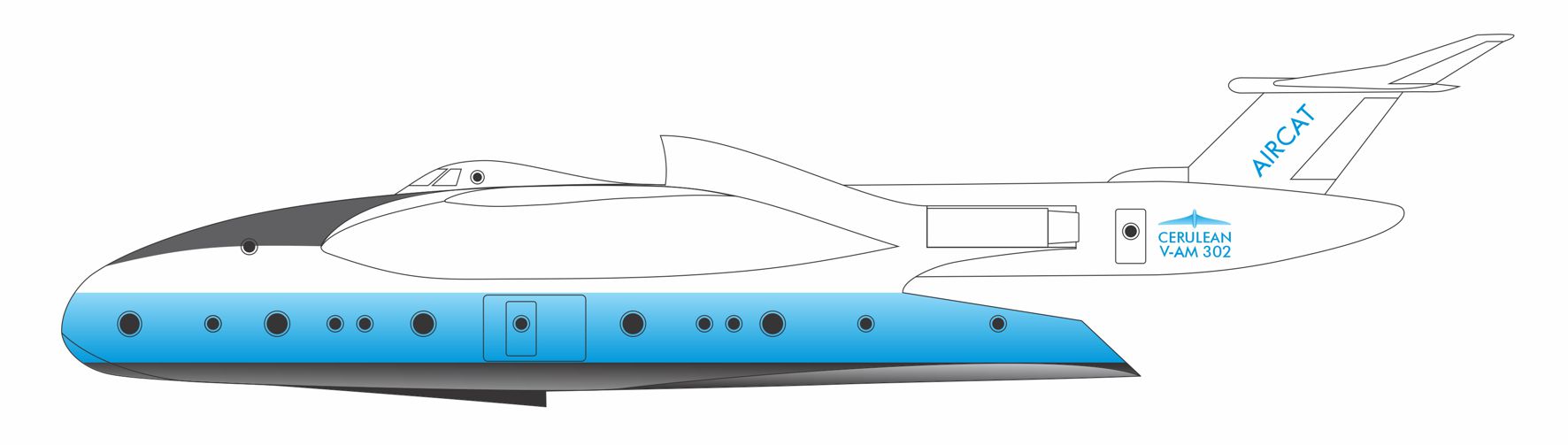
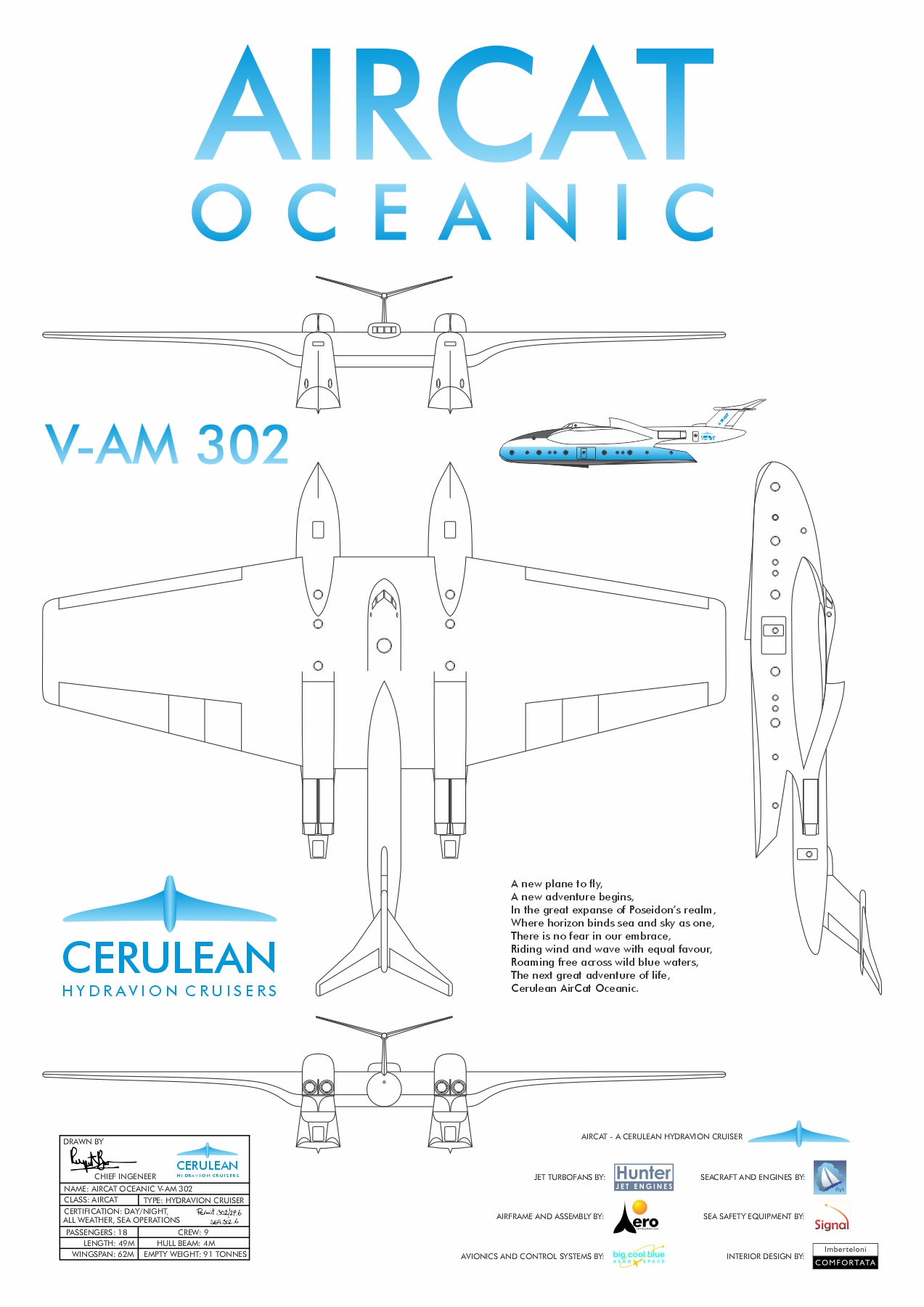
The Aircat Oceanic Plan Poster showing the external configuration of the hydravion.
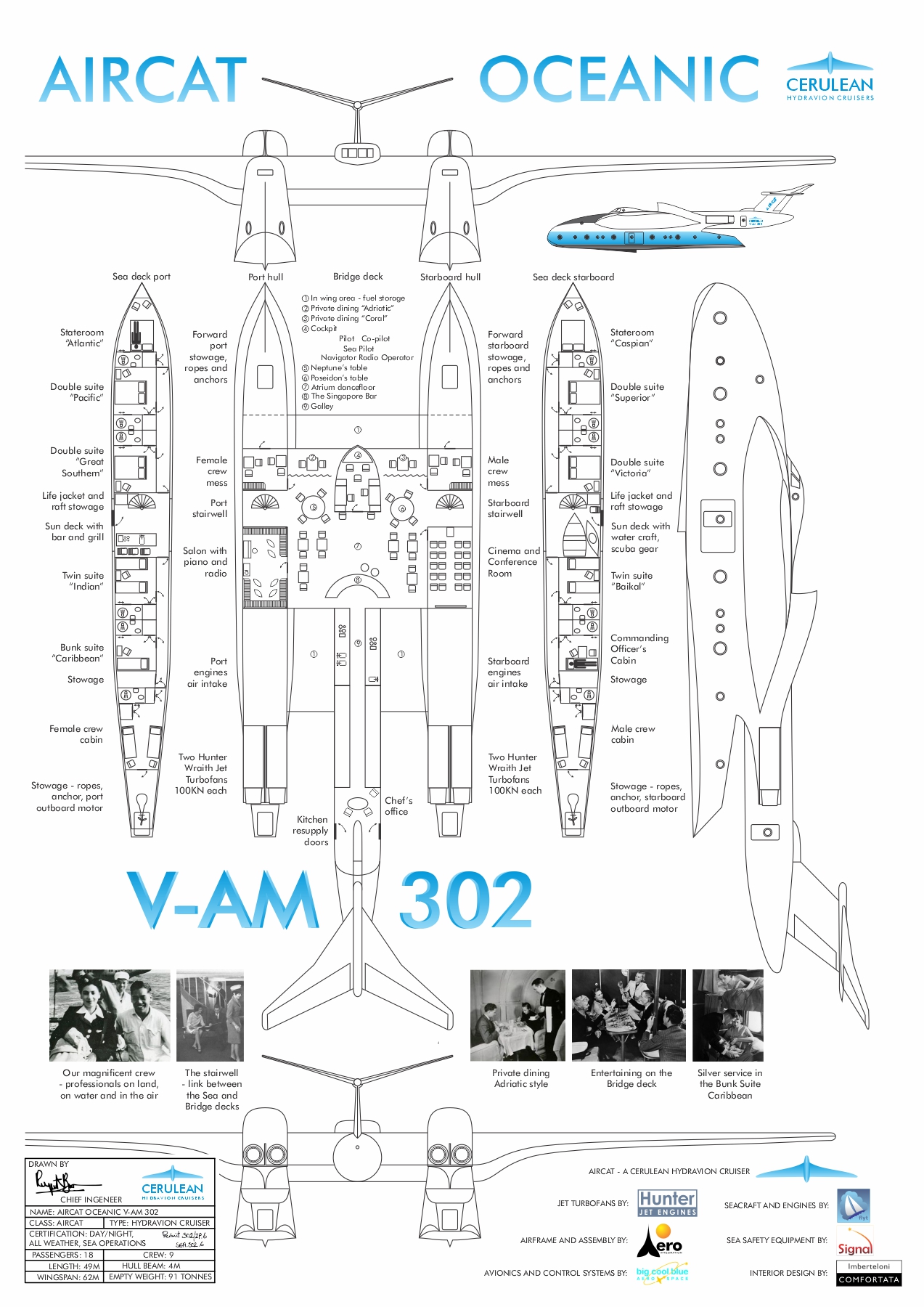
The Aircat Oceanic Layout Poster showing the internal configuration of the hydravion.
Inspiration
You could be forgiven for thinking that a twin hulled flying boat is just a crazy idea. Nobody would ever build that - and even if they did it would never fly. Well, no, it's not a crazy idea at all. It's an Italian idea.
In 1924 the Italian company of Savoia-Marchetti built a twin-engine twin-hull cantilever-monoplane flying boat called the S.55. It was built in both commercial and military variants and in its day was very successful. S.55s had many exciting exploits, but perhaps the most famous and spectacular of them was when Italian Maresciallo dell'Aria (Air Marshal) Italo Balbo organized multiple Atlantic crossings using a squadron of Regia Aeronautica S.55s. These culminated in a flight from Orbetello, Italy on 1 July 1933 with 24 aircraft to Chicago's Century of Progress International Exposition, in just over 48 hours, while maintaining formation.
I love the idea of flying boats, but twin-hulled flying boats! Double goodness, and so Italian.
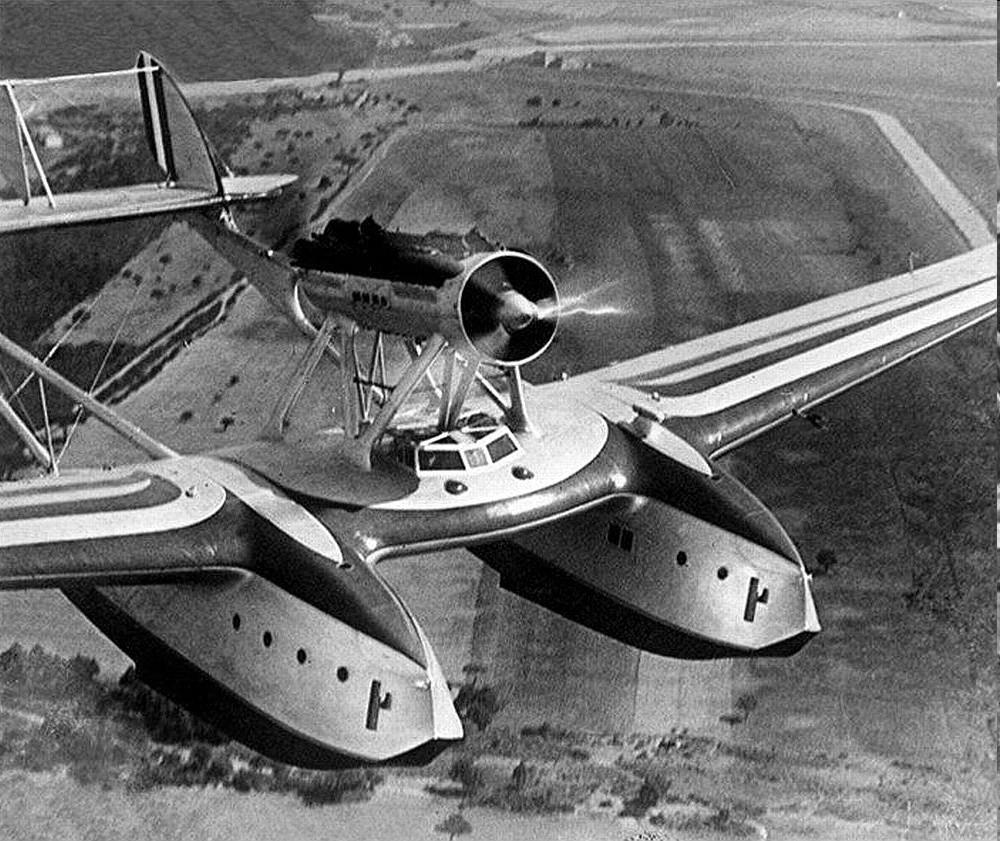
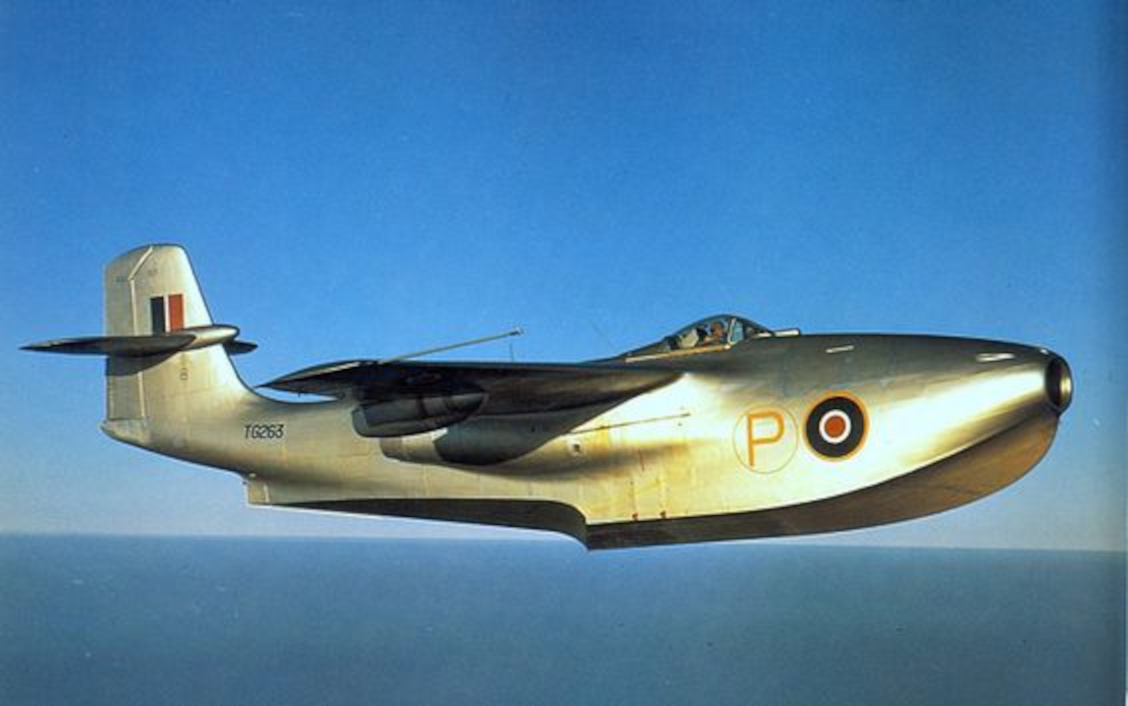
If a twin hulled flying boat is not such a mad idea, then a jet powered one has to be. Again no. There were several serious attempts at building a jet powered flying boat. For my money, the cutest has to be the Saunders-Roe SR.A/1. It never made it past the prototype stage. That big boat shaped fuselage meant that it was never going to be able to compete against the much sleeker and lighter ground based fighters. Today there is an operational jet flying boat in the form of the Russian Beriev Be-200.
You should be convinced by now that a jet powered twin-hulled flying boat is a realistic proposition. But a flying hotel like Aircat - that's not sensible. Well back in the 1930s they just did these things. In my opinion the most beautiful flying boat ever made was the Short Empire class.
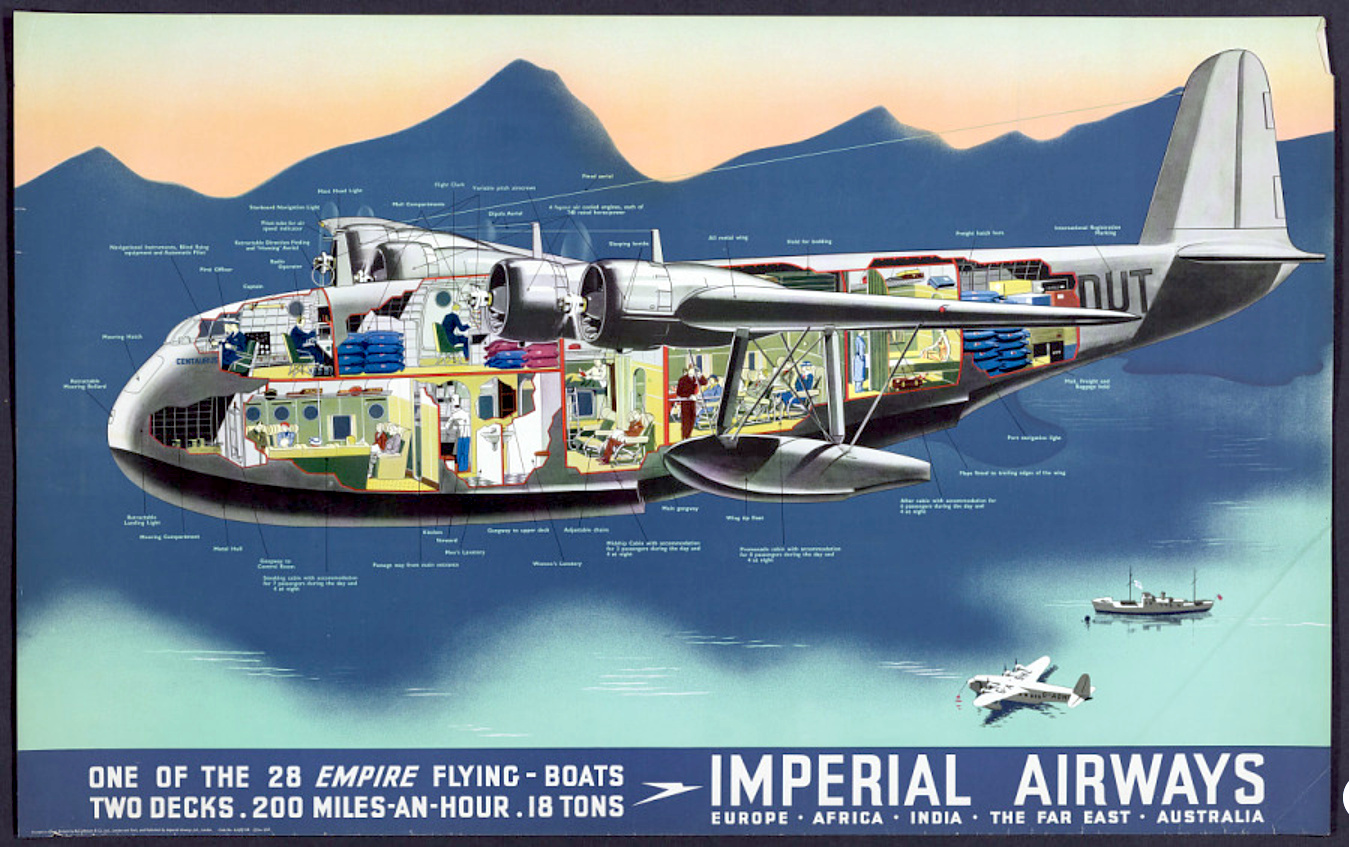
Flying boat history provides rich material for reimagining what might have been.
Aircat Oceanic backstory
The 1950s was a time of optimisim. The world was a more stable place after the great upheavals of the Second World War. Rationing was coming to an end. The wealthy had more money than they had ever had, and amongst that group was a desire to travel, party and have unique adventures. The jet engine had developed into a reliable and powerful means of propulsion. It was in this environment that Cerulean started to plan the form and function of the Aircat Oceanic.
The unique proposition for "air tours" as described by Cerulean, was that Aircat could get you directly to inaccessible places - places that would be very tiresome to visit if you had to do it by conventional means. This included the great lakes and rivers of Africa and India, and the many thousands of islands in the South Pacific and Caribbean.
Add to this the potential for Aircat, in military guise, to act as a long range ocean reconnaissance aircraft, a search and rescue aircraft and a submarine hunter and Cerulean concluded the gamble was a good one.
Work started in the early 1950s at Rochester with an initial build of twelve "air tour" aircraft and two for military trials. In total twenty four "air tour" variants were completed and were in active service right up to the end of the 1970s. Military variants were sold to the UK, Australia, Canada and New Zealand. The Australian Aircats stayed in service well into the 1980s and formed a very successful flying medical centre role travelling between the small nation states in the South Pacific.
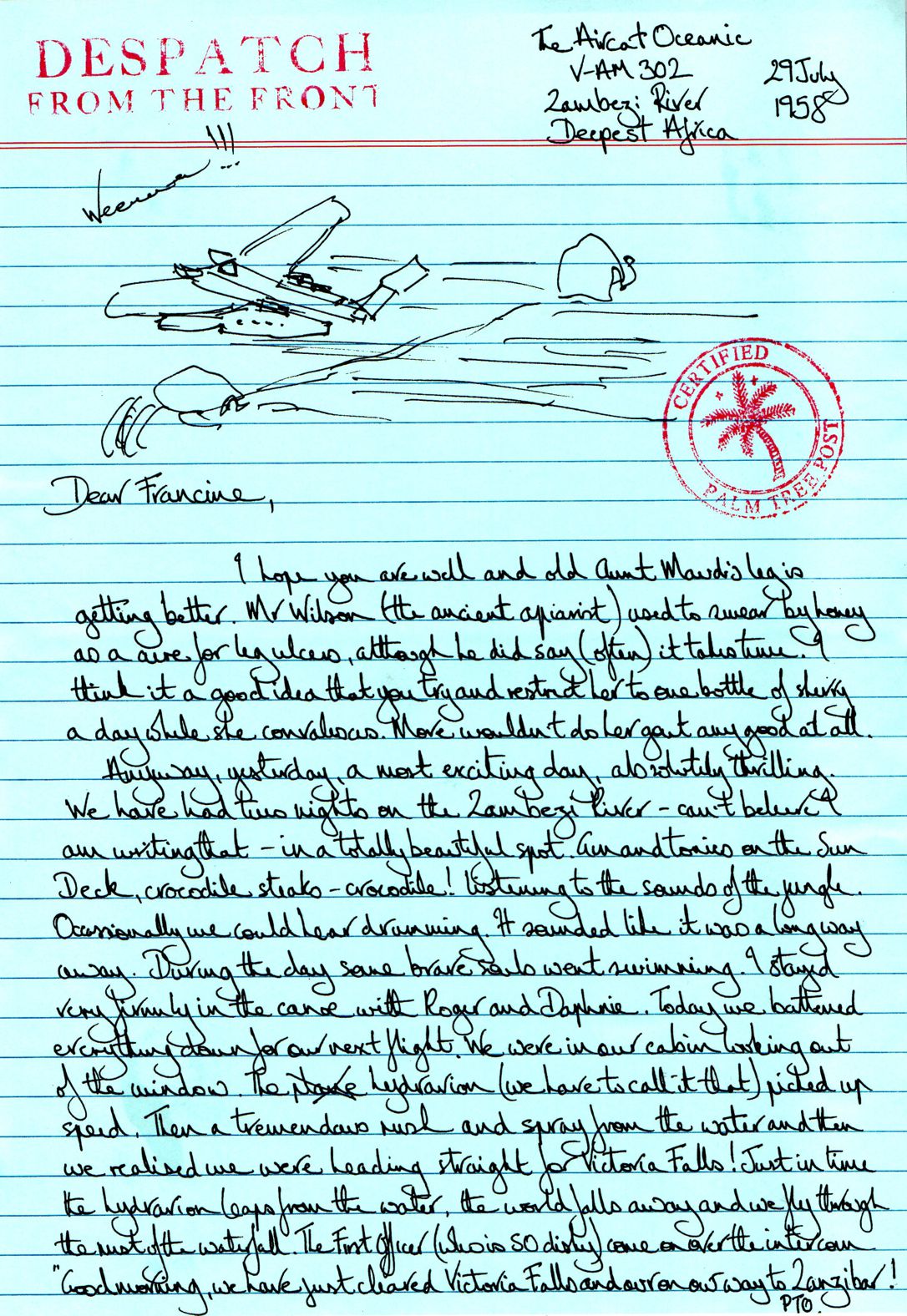
The following is a letter written by a very excited passenger on an "air tour" on the Zambezi River. Wherever there was calm water, you could land an Aircat.
Aircat Oceanic short story "Charlotte"
Read the Aircat short story Charlotte. A young woman rejects a man's love, but he feels determined to build a life for them.
Aircat Oceanic plan
The Aircat Oceanic borrows and extends the design of the revolutionary twin hulled seaplanes from the Italian firm of Savoia-Marchetti. Aircat brings the Savoia-Marchetti configuration into the jet age. Four engines have their intakes protected from the water by being above the wing, there is a high tail, and a huge amount of accommodation from twin hulls braced by the central wing section which houses the cockpit. As any catamaran captain will tell you, having two hulls makes for a very stable vessel and in an aircraft removes the need to have floats positioned out on the wings - in keeping with Cerulean's "lean, clean wing" philosophy.
Aircat Oceanic layout
The huge space afforded by the Aircat's twin hulls and central wing section allow for nine passenger suites, a lounge, a cinema and conference room, a restaurant and two sun decks with direct access to the water. This is Aircat in its most opulent cruising configuration. Other variants included a standard passenger carrying layout, albeit with a splendid dining cabin and bar, and a military submarine hunter model sporting twin two inch rapid firing cannon as well as depth charges and torpedoes.